A new study by the Insurance Institute for Highway Safety (IIHS) has confirmed a significant gap between actual smartphone use while driving and what appears in police reports. According to telematics data, in the final 30 seconds before a collision, 7% of drivers involved in single-vehicle crashes and 8% in two-vehicle crashes were using their phones. Police reports for the same incidents recorded this figure at less than 1%. The degree of underreporting thus reaches at least sevenfold. A significant portion of smartphone interactions is nearly invisible to bystanders, and drivers rarely admit to being distracted. Moreover, reports often lack precise classification of the type of device use. "It is widely acknowledged that police reports frequently fail to reflect the role of mobile phones in crashes. Many smartphone functions are difficult for a witness to notice, and drivers are reluctant to admit distraction," said IIHS President David Harkey. He noted that telematics makes it possible to assess the true scale of the problem. IIHS researchers used anonymized data from Cambridge Mobile Telematics (CMT), collected through safe-driving apps in which users participate voluntarily. Crashes recorded by these apps were matched against police reports in four U.S. states covering the period from 2021 to 2024. A "match" was defined as falling within a 15-minute window and a 1-mile radius. The final sample comprised nearly 17,000 linked cases. The methodology relied on clear definitions. Active use includes phone manipulation (taps, swipes, holding), handheld calls, and hands-free calls. Passive use is recorded when the screen is unlocked but the driver is not touching the device — for example, during navigation or video playback. Telematics identifies whether the screen is unlocked and the type of interaction, but does not track specific apps. For 15,301 two-vehicle crashes, telematics recorded within 10 seconds before impact: 14 handheld calls, 53 hands-free calls, 287 instances of phone manipulation, and 337 episodes of passive use. In the 30-second window, those figures rose to 19, 87, 590, and 534 respectively. Police reports for the same crashes recorded only 6, 1, 17, and 15 cases. The contrast is striking. The picture for 1,543 single-vehicle crashes is equally telling. Telematics (10-second window) identified 2 handheld calls, 0 hands-free calls, 23 instances of phone manipulation, and 40 episodes of passive use; in the 30-second window, the figures were 3, 3, 49, and 52. Police reports captured 1, 0, 3, and 5 cases. The gap between the two sources remains enormous regardless of crash type. Phone manipulation was the most common behavior observed before crashes, while calls occurred far less frequently. Passive use was comparable in frequency to active use. Telematics captures the fact of screen interaction but does not reveal which specific apps are distracting drivers. Researchers suggest that the most common culprits are services requiring sustained attention: messaging apps with active correspondence, work task planners, dating apps, and sports betting apps. The latter are particularly relevant among male drivers on football match days. Mobile betting apps are offered by most major online bookmakers, and their user base is growing worldwide. The scale of this market can be gauged from data on the best apps from online bookmakers, compiled on the page of one of the industry sites reviewed. Beyond visual distraction, such apps trigger an adrenaline response when odds shift or results change, further reducing a driver's reaction time. It is precisely the combination of cognitive load and emotional arousal that makes these smartphone use scenarios particularly dangerous on the road. Any distraction increases risk, but tasks that draw the eyes away from the road are especially hazardous. Looking away for just 2 seconds doubles the likelihood of a crash or near-crash. The proliferation of screen-based apps compounds the problem. "The apps may be new, but the danger is not. Any use of a phone that takes a driver's eyes off the road can increase crash risk," emphasized lead study author Aimee Cox. Passive use may be associated with navigation, but in a separate IIHS survey, nearly 25% of drivers admitted to watching video on their phone while driving at least once in the past 30 days. Research by the U.S. Department of Transportation found that some of the longest glances before crashes and near-crashes were directed toward the center of the dashboard, where phone mounts are commonly placed. Telematics, however, does not capture whether a driver was looking at the screen or for how long. Even a brief glance at https://bookabet.ug/ or taking a hand off the wheel to launch a music app can be enough to trigger a dangerous situation on the road. Even when both sources noted phone use, the type of activity matched in only 3 cases out of nearly 17,000. This discrepancy in classification further compounds overall underreporting and makes accurate risk assessment more difficult. If "legal" forms of phone use go unrecorded in reports, lawmakers risk underestimating the true threat. Twenty-one states have already banned handheld phone use while driving. According to IIHS, such rules are easier to enforce and more effective than targeted bans on specific actions such as texting or handheld calls. The study has several limitations. It is unknown who was the at-fault driver. A causal link between phone use and the collision has not been established. Data on the direction and duration of the driver's gaze are unavailable. Specific apps are not recorded. Some scenarios involving CarPlay or Android Auto, where screen unlocking may not be required, fall outside the sample entirely. The findings suggest that telematics can measure the scale of distracted driving more accurately than existing police reporting systems, and may serve as a compelling argument for reconsidering how the "phone factor" is recorded in crashes, as well as for broader discussions about restrictions on smartphone use while driving.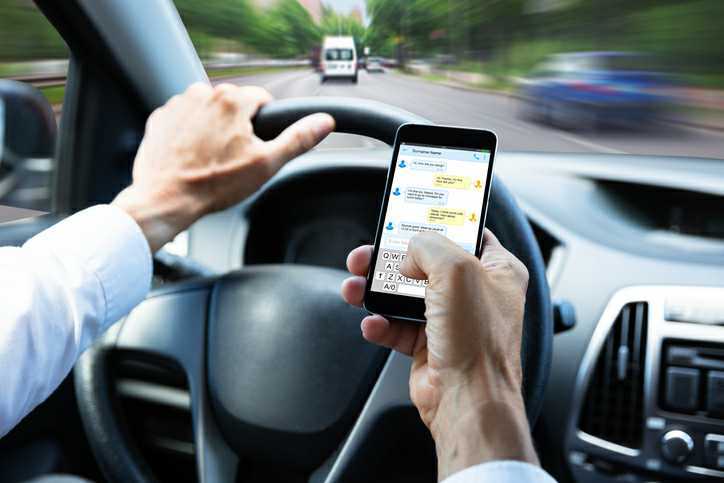
Why police statistics fail to capture phone use
How data were collected and what was compared
What lies behind the numbers in two-vehicle and single-vehicle crashes
Screen touches, not calls, proved to be the primary threat
Navigation, video, and the center of the dashboard as sources of prolonged distraction
Laws that have fallen behind the smartphone screen
hablamos espaÑol (310) 226-6890

Request a free consultation (310) 226-6890